
Defeating Ransomware and Kinetic Threats with Immutable Cross-Region Backups

Case Studies
Let's discuss
a solution
for you!
Speak to one of our experts on how we can supercharge your data journey
Overview
AeroTrans Logistics, a major aviation and supply chain network in The Peninsula, relied heavily on continuous data availability to route international cargo. They faced two distinct threats: a surging regional ransomware epidemic targeting logistics firms, and an underlying vulnerability to cascading power grid disruptions.
Their existing "warm standby" disaster recovery environment was located in the same geographic region as their primary setup. A direct kinetic strike on regional power grids would take down both environments simultaneously, while a ransomware worm could easily traverse their connected architecture.
Dataring's BCDR consulting practice specializes in exactly this kind of converged threat scenario, where cyber and physical risks must be addressed as a single integrated resilience program.
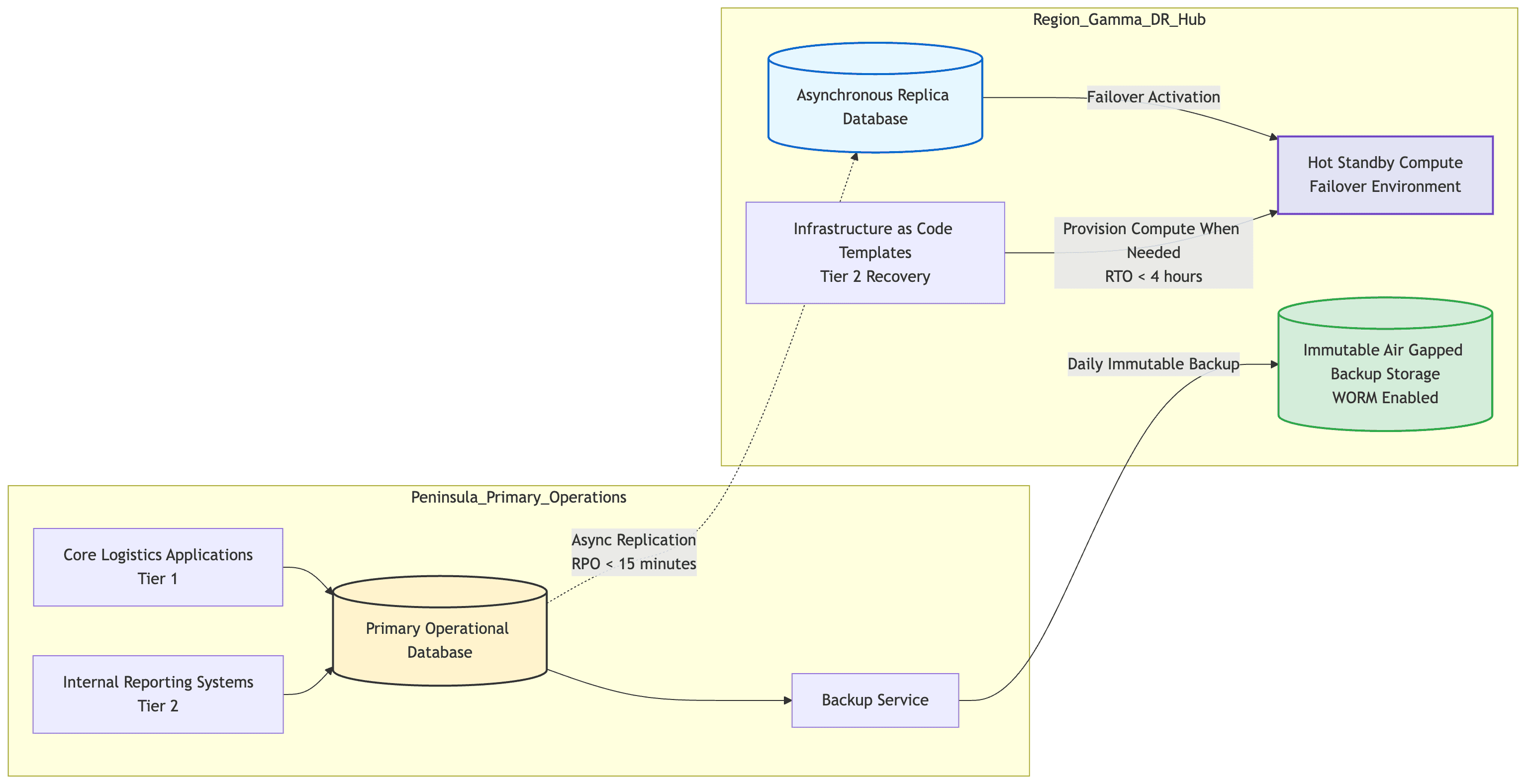
For their Tier 1 (Core Apps) and Tier 2 (Internal Reporting) systems, an active-active setup was cost-prohibitive. Instead, we designed a highly resilient Pattern A: Hub-and-Spoke architecture, prioritizing air-gapped data survival.
Immutable, Air-Gapped Backups
We decoupled their backup infrastructure from the primary network. Backups were sent to an off-shore cloud region using immutable storage (WORM: Write Once, Read Many). Even if administrators' credentials were compromised in a cyberattack, the backups could not be deleted or encrypted.
Asynchronous Replication
We established a hot standby in Region Gamma (80 to 120ms latency away from primary). This asynchronous pipeline ensured that if The Peninsula experienced a massive blackout, workloads could auto-failover with an RPO of under 15 minutes.
Infrastructure-as-Code Recovery
For Tier 2 workloads, we utilized IaC templates stored in the remote region to spin up necessary computing power dynamically, drastically reducing standby cloud costs while meeting a 4-hour RTO.
Product Integration
DataFlow manages the entire backup orchestration pipeline — scheduling nightly WORM snapshots, monitoring replication lag, and triggering the IaC recovery sequence when a failover is declared. DataBridge provides the query abstraction layer that lets AeroTrans applications seamlessly read from the Hub DR environment without reconfiguring connection strings. Post-recovery, DataQualityHQ runs automated validation checks to confirm backup integrity and flag any records that diverged during the asynchronous replication window.
AeroTrans eliminated their single-region failure risk within 90 days. When local telecom providers experienced severe connectivity drops due to nearby infrastructure damage, AeroTrans executed a component failover to the Hub DR environment, maintaining full operational visibility over their global fleet.
DataFlow's automated orchestration reduced what would have been a multi-hour manual runbook to a single triggered sequence, while DataQualityHQ confirmed that shipment tracking data across all hubs matched within the expected RPO tolerance.
See how we approach different tiers of resilience: Zero Downtime with Active-Active Architecture for Tier 0 critical banking systems, or Multi-Provider BCDR for Critical Infrastructure for the most advanced multi-cloud recovery pattern.
Get in touch to evaluate your organization's resilience posture.
Single-region risk eliminated: Within 90 days
Backup strategy: Immutable WORM storage, air-gapped from primary network
Architecture pattern: Hub-and-Spoke Disaster Recovery (Design Pattern A)
RPO achieved: Under 15 minutes (asynchronous replication)
RTO for Tier 2 workloads: 4 hours via Infrastructure-as-Code recovery
Result: Full operational visibility maintained during real-world telecom disruption