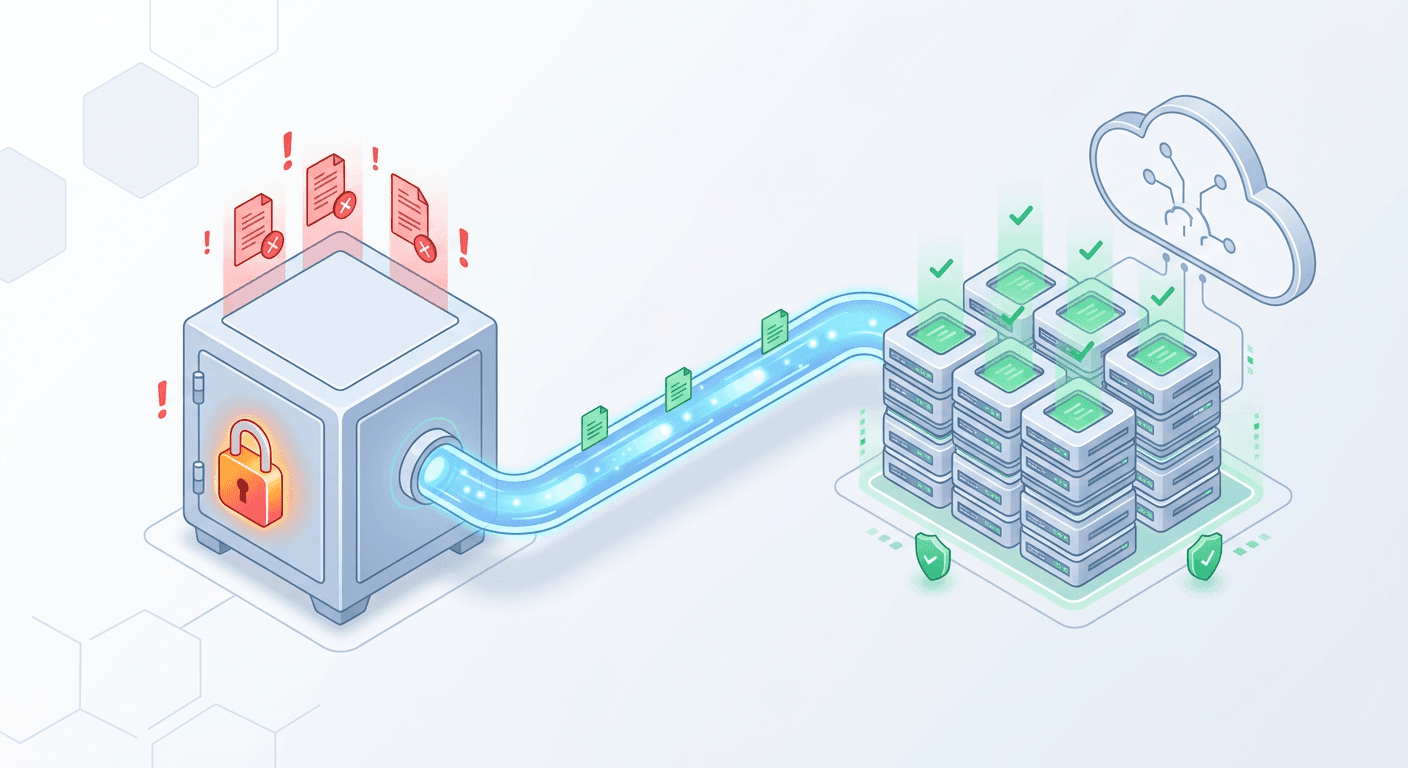
Backups That Survive Ransomware and Region Loss: A Practitioner's Guide
BCDR

Mahesh Chandran
CEO Dataring
In the post-incident reviews I've read or participated in, backup failure is almost never about the absence of backups. It's about backups that exist on paper but cannot be relied on under the conditions where they're actually needed. Either an attacker reached the backups before the team did, or the backups were physically co-located with the production environment and went down with it, or the backups were never tested for restorability and silently corrupted, or some combination of these.
After the March 2026 Gulf cloud incident, the assumption that any one of these failure modes was hypothetical no longer holds. This post is about what survivable backups actually look like and how to build them. For the broader BCDR architecture context, see our cloud DR in the GCC pillar.
The thesis
A backup that survives the threats actually present in the GCC has four properties: it cannot be modified or deleted by an administrator (immutability), it cannot be reached from the production network by a worm (isolation), it does not share a physical blast radius with production (dispersion), and it has been actually restored, recently, to working compute (verified restorability). The first three are usually present in the architecture diagram. The fourth is the one most often missing.
Why traditional backups fail against modern threats
Most enterprise backup setups share two structural vulnerabilities that attackers and physical events have learned to exploit.
The traversal problem. Modern ransomware does not encrypt production data immediately. The attacker maps the network, identifies backup infrastructure, compromises administrator credentials, and only then triggers the encryption payload. By the time the team reaches for backups, the backups have been encrypted, corrupted, or deleted alongside production. Where the backup target is reachable from production with privileged credentials, that path is the attack path. Industry reporting on regional breach impact varies by source and methodology; specific figures should be checked from current data, but the directional finding is consistent across sources.
The co-location problem. Even cyber-resilient backups are typically stored in the same geographic region as production. When physical infrastructure in that region is affected — outage, fire, kinetic event — production data, backup data, and recovery infrastructure can be lost together. Co-location turns a regional event into a total data loss event.
The Four Properties
Survivable backups have four properties simultaneously. Each is a discrete engineering choice. Missing any one creates a specific, exploitable vulnerability.
Property 1: Immutability
Immutable storage uses WORM (Write Once, Read Many) primitives to guarantee that once data is written, it cannot be modified, overwritten, or deleted for a defined retention period. Even with compromised root credentials, an attacker cannot alter or destroy immutable backups. The storage platform enforces the retention lock at the infrastructure level, below the operating system and above the physical media.
In practice: configure backup target storage with object lock policies (S3 Object Lock, Azure Immutable Blob Storage, GCS Bucket Lock) with a retention period that exceeds your maximum expected detection time for a ransomware infection. If your team's typical dwell time is 14 days, retention should be at least 30. The most common engineering mistake I see is setting retention shorter than dwell time, which makes the immutability theoretical.
Property 2: Isolation
Backups must be unreachable from the production network on a privileged path. The principle: no network path should exist between production and backup that could let a worm or compromised administrator traverse into the backup system.
In a cloud environment this means storing backups in a separate cloud account (not just a separate VPC or subnet within the production account), in a different region, with independent IAM credentials and no cross-account trust relationship to production. The replication pipeline is a one-way push from production to backup, with no inbound network access from any source. The diagnostic question: if a production administrator account is compromised, what backup-side actions can the attacker take? If the answer is more than "none," isolation is incomplete.
Property 3: Geographic dispersion
Backups must be stored in a region geographically separated from production by enough distance to exceed any localized physical blast radius. For organizations operating in the GCC, this typically means backup storage in Europe, North America, or APAC, rather than in a neighboring Middle East availability zone or region.
Dispersion has a regulatory dimension that's worth surfacing. Data residency rules in some GCC jurisdictions constrain where backups can sit. The right path is not to ignore the rules; it's to negotiate pre-approved exception frameworks for emergency cross-border failover. See our residency guide for the playbook.
Property 4: Verified restorability
A backup that has not been tested for restoration is a wish, not a backup. Restorability is the property most often missing in real environments and least often surfaced by audits. Backup pipelines silently corrupt for many reasons — schema drift, encryption-key rotation issues, missing dependencies, incomplete snapshots — and the failure becomes visible only when restoration is attempted.
Verified restorability requires automated, scheduled restore tests against ephemeral compute, with checksums validated against original data and at least sampled functional verification (does the restored database accept queries? does the application start?). In the engagements I've done, the most common gap I see in otherwise mature backup setups is here: the team has all three earlier properties and has never run a real restore.
The 3-2-1-1 rule, restated
The classic 3-2-1 rule (three copies, two media types, one offsite) was written before ransomware made compromise of the backup system itself the default attack path. The 3-2-1-1 rule restores the missing property:
3 copies of data: production, near-line backup (fast recovery from routine failures), offsite backup.
2 media types: at minimum, block storage for production and object storage for backups; in practice, different cloud providers for production and backup also satisfies this and adds provider diversity.
1 copy offsite: in a geographically remote region, separated from production by enough distance that a single physical event cannot affect both.
1 copy immutable: at least one backup copy on WORM storage that cannot be deleted or modified regardless of administrator access.
The Four-Stage Pipeline
A production-grade backup pipeline that satisfies the four properties has a recognizable shape:
Stage 1: Continuous near-line replication
Production databases and critical file systems replicate continuously to a staging area within the same cloud region. This is for fast recovery from routine failures — corrupted writes, accidental deletions, application bugs — with RPO measured in seconds. This stage is not the disaster recovery layer; it's the routine resilience layer that runs underneath.
Stage 2: Scheduled cross-region transfer
At defined intervals (typically every 15 minutes for Tier 1 workloads, hourly for Tier 2), the staging area pushes encrypted snapshots to the remote DR region. The transfer is asynchronous, so production performance is unaffected by cross-region latency. Disaster RPO equals the transfer interval.
Stage 3: Immutable write to WORM storage
On arrival in the remote region, snapshots are written to immutable object storage with a retention lock. Once written, snapshots cannot be modified or deleted by any principal, including the account root user, until the retention period expires. This is the property that defeats both the traversal attack and the malicious-insider failure mode.
Stage 4: Integrity verification
Automated integrity checks run daily against immutable backups. Checksums validate against source. Sampled snapshots restore to ephemeral compute and pass functional smoke tests. Failures alert immediately to the on-call rotation. This is the stage that converts "we have backups" to "we have working backups," and it's the stage organizations most often defer.
Common implementation pitfalls
A few patterns that show up across engagements:
The IAM trust path that defeats isolation. Backup accounts often have a cross-account role that the production account can assume "for management purposes." That role is the traversal path. If it exists, isolation is theoretical.
Retention lock applied to bucket, not objects. Bucket-level retention can be modified by a privileged user. Object-level retention cannot. Verify the configuration is at the object level.
The integrity check that doesn't actually restore. A checksum match is a useful signal but not a restoration test. Restoration to ephemeral compute that runs at least one functional smoke test is the bar.
The encryption-key dependency. If backups are encrypted and the encryption key only lives in the production region, losing the production region loses the key, which means losing the backups. Keys must be managed independently and replicated to a regional path that the backup workflow can reach without depending on production.
The scheduled-window assumption. Some teams disable replication during weekly maintenance windows. The maintenance window is exactly when an attacker would prefer to act. Replication should run continuously, with maintenance handled by graceful queueing rather than pause.
Tradeoffs and honest limitations
Cross-region storage and egress have a cost. Geographic dispersion is not free. For Tier 2 and Tier 3 workloads, the cost may not be justified at the immutable-tier specification; cheaper, less-protected backup tiers may be the right choice. Pattern selection should follow workload tier; see our pattern decision guide.
Restorability testing requires investment. Real restore tests consume engineering time, ephemeral compute, and operational attention. They are also the highest-leverage hour your team will spend in any given month. Budget for it explicitly rather than letting it be the optional step that gets deferred.
Residency rules constrain dispersion. For data classes that genuinely cannot leave a jurisdiction, the right answer is not to violate residency, but to negotiate pre-approved exception frameworks for emergency conditions. The work is regulatory, not technical.
The four properties don't address application-level recovery. A correctly restored database is not a recovered application. Application-level state, configuration, and integration health all need to be addressed separately. The data layer is necessary but not sufficient. See our post on post-failover validation.
A practical takeaway
If your organization has backups but cannot answer "when did we last actually restore one to working compute, and what did we learn?", verified restorability is the gap. The 30-day project is to schedule a real restore test for the most critical backup target, run it, document the gaps, and remediate. Once one target is verified, the pattern scales. Until one target is verified, the entire backup program is unproven.
For the pattern decision that determines how much backup investment a given workload justifies, see our pattern decision guide. For the validation work that follows a restore, see our post-failover validation post. For the regional context, see our cloud DR in the GCC pillar. If you'd like outside support assessing your backup architecture or running a verified restore exercise, Dataring's resilience practice does this engagement regularly. Get in touch.