What the AWS Data Center Strikes Mean for Your Disaster Recovery Plan
BCDR

Mahesh Chandran
CEO Dataring
On March 1, 2026, drone strikes physically destroyed two AWS data centers in the UAE and damaged a third in Bahrain. Within the same 72-hour window, over 150 coordinated hacktivist attacks targeted banks, aviation networks, and government systems across the GCC. It was the first confirmed kinetic military attack on a hyperscale cloud provider in history.
If your organization operates cloud infrastructure in the Middle East, or relies on cloud services hosted in the region, this event has immediate implications for your disaster recovery plan. This article explains what happened, what it exposed, and what specific actions you should take. For the full technical deep dive, read our comprehensive guide to cloud disaster recovery in the Middle East.
What Actually Happened
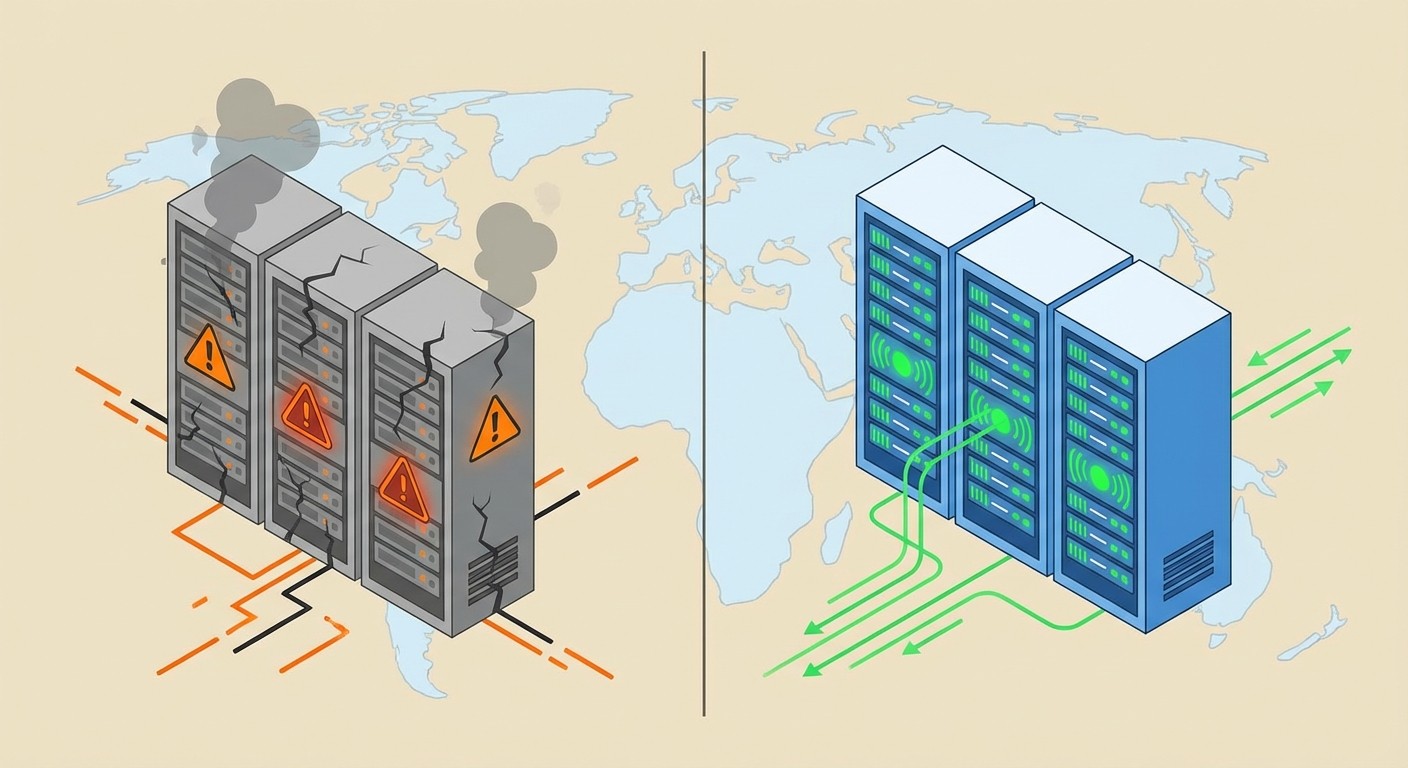
Following coordinated US-Israel military operations (Op. Roaring Lion / Epic Fury) on February 28, 2026, retaliatory drone and missile strikes were launched across the Gulf. On March 1, objects struck the AWS mec1-az2 data center in the UAE, causing immediate fires and power loss. Amazon EC2, S3, and DynamoDB went offline in that availability zone. By 13:46 UTC, power disruptions cascaded into the adjacent mec1-az3 zone. Because S3 is designed to survive the loss of a single availability zone but not two simultaneously, regional S3 architectures began failing.
Simultaneously, CloudSEK documented over 150 hacktivist incidents claiming DDoS attacks and breach attempts against GCC financial, telecom, and aviation targets. Organizations were fighting cyber attacks while their primary cloud infrastructure was physically on fire.
Three Assumptions That Died on March 1
Assumption 1: Multi-AZ Equals Disaster Recovery
The vast majority of organizations operating in AWS Middle East relied on multi-AZ deployments as their disaster recovery strategy. Availability zones within a single region are typically separated by single-digit kilometers and share regional power grid dependencies. Multi-AZ provides excellent redundancy against hardware failures and localized outages. It provides zero protection against a military strike that affects multiple AZs in the same region.
If your current DR strategy is "we run in multiple AZs," March 2026 proved that you do not have a disaster recovery plan for the threats that actually exist in this region.
Assumption 2: Cloud Infrastructure Cannot Be Physically Destroyed
Cloud computing's entire value proposition is abstraction: you do not need to think about the physical hardware. This abstraction created a dangerous cognitive bias where organizations treated cloud services as immune to physical reality. The March 2026 strikes proved that cloud data centers are concrete buildings, connected to power grids and subsea cables, located at known GPS coordinates. They are as physically vulnerable as any other building.
Under the cloud shared responsibility model, the cloud provider is responsible for the resilience of the cloud (the building, the hardware), but you are responsible for resilience in the cloud (your data, your applications, your recovery architecture). When the building burns, the provider will eventually rebuild it. Your data, if it was only in that region, is gone.
Assumption 3: Cyber and Physical Threats Are Separate Events
Traditional enterprise disaster recovery plans are compartmentalized. The physical security team handles building emergencies while the SOC handles cyber incidents. March 2026 proved that in a conflict zone, these are not separate events. They are a coordinated campaign. Organizations were required to respond to massive DDoS attacks at the exact moment their cloud management APIs, monitoring dashboards, and security control planes were offline because they were hosted on the infrastructure that had been physically destroyed.
This is the simultaneity problem: when the hardware burns, the control plane burns with it. Software failover cannot fix physical destruction.
What This Means for Your DR Plan
If your organization operates cloud infrastructure in the GCC, or if your customers, partners, or SaaS providers host data in the region, here is what you need to reassess.
If You Operate in the GCC Directly
Your disaster recovery plan must be rebuilt around the assumption that your entire primary cloud region could be physically destroyed while a simultaneous cyber attack degrades your communication channels. This means multi-region architecture with geographic dispersion beyond the blast radius, provider-independent DNS and identity management, immutable air-gapped backups in a remote region, and regular testing that simulates both kinetic and cyber threats simultaneously.
The right architecture depends on your workload criticality. Our BCDR pattern comparison framework breaks down the three options: Hub-and-Spoke DR for Tier 1 workloads, Active-Active Multi-Region for Tier 0 systems, and Multi-Provider Cross-Region for critical national infrastructure.
If You Rely on SaaS Providers Hosted in the GCC
March 2026 is a wake-up call for third-party risk management. If your organization relies on SaaS platforms, payment processors, or data services that are hosted in GCC cloud regions, you need to ask your providers directly: What happens to our data if your primary region is physically destroyed? What is your cross-region recovery capability? Where are your backups stored? If they cannot answer these questions with specific RTO, RPO, and geographic dispersion details, that is a material business risk.
If You Serve GCC Customers from Outside the Region
If your organization is based outside the GCC but serves customers in the Middle East, the March 2026 events may actually work in your favor from a resilience perspective, since your primary infrastructure is not in the affected region. However, you need to ensure that any data replicated to GCC regions for latency or compliance purposes has a survivable recovery path, and that your customers understand the trade-offs between data residency compliance and data survival.
The Five Things to Do in the Next 30 Days
Inventory your GCC exposure. Identify every workload, database, backup, and SaaS dependency that touches a Middle East cloud region. Ask the hard question: if this facility is physically destroyed tomorrow, how long until we recover?
Establish an immutable off-region backup immediately. Before designing complex multi-region architectures, create a survival baseline. Route your critical data to immutable storage in a remote region within 72 hours. This is the fastest thing you can do to reduce your exposure.
Engage your regulators on data residency exceptions. If you operate under SAMA CSF, NESA, or QCB, begin the conversation about pre-approved emergency cross-border data migration frameworks now. Do not wait for a crisis to ask permission.
Run a tabletop exercise based on the March 1 timeline. Bring your C-suite, physical security, and cybersecurity teams together. Walk through a scenario where your primary cloud region goes offline while a DDoS attack hits your secondary systems. Document every gap in your current plan.
Assess your architecture pattern. Use the BCDR pattern comparison framework to determine which architecture pattern (Hub-and-Spoke, Active-Active, or Multi-Provider) is appropriate for each tier of your workloads.
Getting Started
Dataring's BCDR consulting practice was built specifically for the post-March 2026 threat landscape. We deliver integrated business continuity and disaster recovery programs for organizations operating in the GCC, from readiness assessments through architecture design, implementation, and Level 4 resilience testing.
Get in touch to schedule a complimentary Readiness Assessment. For definitions of the technical terms used in this article, see our BCDR glossary.